I was convinced the online slot I was playing was rigged. Because when I started playing, it would start by giving me a lot of payouts. But after a while, it completely stopped paying off anything. It almost felt like it was paying initially to get me hooked and stopped paying off when I was hooked.
To add to the doubt, as soon as I made up my mind to not add any more money and quit, it gave me a decent win. Almost as if it knew when I was about to leave and gave me a bonus just to keep me continue playing.
After much research, the answer to my doubts is that slots are RNG. And they do not need to be rigged to be profitable to casinos.
The simple answer is, the slots work according to the law of large numbers. Over a period of time, slots will pay less than what’s put in.
So in the sense that Casinos are cheating the programming or machinery of the slots; they most likely are not. Most land based casinos and licensed online casinos have to abide by strict regulations to ensure fair play.
So what feels like skewed programming, is something that can happen over a long period of time if RNG and a house edge (RTP) is involved.
That’s what I found out back then, and used it to convince myself that it’s okay to continue gambling on slots. After all, I was due a big win after spending so much on it. Even if the house always wins, there is a chance I can still hit big. Besides, at that point, it was just harmless fun, even if I was spending a lot of time and money on slots. It helped destress me and forget about things going on in my life that I didn’t want to think about.
But that information, in the opinion of my present self, was incomplete. It only spoke of odds and maths and ignored the human side of gambling.
The truth is that slots, online or land based, are designed to be extremely addictive. It’s not just the game, it’s everything, from the sound, to the visuals, the convenience, the math and the bonuses. Literally every little detail of the slots is designed to maximize the time you play, and as a result, maximize the amount of money you spend on them.
What’s more alarming is that the more you play, the more you are likely to get addicted to it as your brain becomes accustomed to the quick and continuous dopamine hit. Every game resolves in itself and it provides a type of satisfaction along with the dopamine hit that is very difficult to get elsewhere… at least that was the case for me.
So while I was able to convince myself that slots are not rigged and it’s okay to continue playing them, I failed to truly see the addictive nature of slot machines and how it was affecting me.
A lot of people say that Casinos are just about math. But they are much more than that. They are about psychology and your biology. And how it’s used to extract as much money out of you as possible.
The house always wins not just because the odds favor them, but also because they are designed to keep people playing for as long as possible, sometimes at the expense of the mental, emotional and financial health of a person.
Let me explain in detail…
The Law Doesn’t Allow It
Casinos risk a lot more if they rig the slots. That is, if they cheat the system. It’s just much easier to play fair, keep the systems abide by the regulatory authority of whichever country or state they are licensed in, and continue printing cash.
Why would they cheat and risk their license if the slots already provide them a mathematical advantage?
I am not saying it can’t be rigged.
There have been cases of people actually rigging gambling machines. In the 1980s, a licensed Las Vegas slot-route operator called American Coin was found to have altered software in hundreds of machines so some jackpots wouldn’t be paid.
That was actual rigging. It was cheating. And as a result of it, the operator lost its license.
Technically, it can still happen today. But it’s highly unlikely for an operator to risk losing its business, and the casinos to risk losing their reputation by cheating or rigging a machine.
Especially if the slot or casino is popular, because in large numbers, the math favours them overwhelmingly.
The Math Of Slot Machines
The house always wins. That means the house always has a mathematical edge. Any casino, whether online or land based, keeps a mathematical edge on all its games.
The best example for this is the roulette table. There are 18 red pockets and 18 black pockets, which would make betting on either a 50/50 chance. But add a green zero, where both bets lose, and your chance of winning drops to 48.65%. Some roulette tables have two green pockets to give the house an even greater edge.
With slots, the house edge is computerized. And it’s measured in RTP. Return To Player.
Now when I first learned of RTP, I thought that over time, I will get 96% of what I deposit back to me if I continue to play. So by that calculation, if I deposit $10,000 over a period of five years, conservatively I should get at least 80% or $8,000 back in winnings.
Boy was I wrong. Because I did not fully understand how RTP is actually calculated. And how it works over large numbers.
First, RTP is calculated on amounts wagered. Not the amount you deposit. So if you deposit $100, and you play for a period of an hour, during that one hour, you have won some amount, and lost some amount. Whatever you won, was wagered back into the machine. So that amount counts towards the RTP as well.
To demonstrate this, let me show you what a session would look like if a machine gives you exactly 96% RTP on every spin. So you always win 96 cents on the dollar.
But before I show it to you, let’s me ask you this question…
If you deposited $100 in the machine, made a $1 bet and played a game every 6 seconds for four hours; guess how much money you would have remaining?
Not 96% of $100.
It will be 96% of the amount you would have wagered. Over a period of 4 hours and 10 minutes, you would have wagered everything you won back in the machine, totalling $2500.
And the machine would have given you exactly 96% of it back, that is $2400.
Since you only deposited $100, you would lose all of it by the 4 hours and 10 minutes mark.
You are not leaving the machine with 96% of what you deposited. That would be $96. No, instead you are leaving with Zero because the 96% that was returned by the machine was given back to the machine over and over again until there was nothing left.

But RTP is not calculated only towards your gaming session. It’s calculated over 100,000s of sessions across the life of the machine. So essentially, it doesn’t have to give you a 96% RTP exactly. As long as the average RTP over a long period of time is 96%.
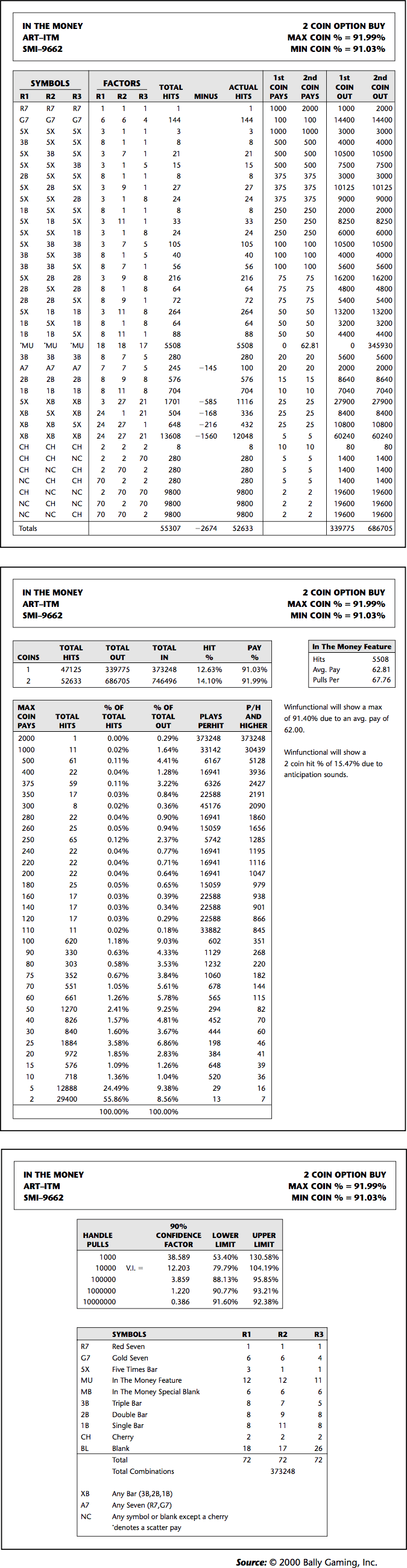
Which brings in the luck factor. To demonstrate it, I built my own PAR sheet for a machine that doesn’t exist, which I call Reference 96. I modelled it on one real manufacturer PAR sheet, a Bally sheet from 2000, and two PAR sheet reconstructions by Michael Shackleford at Wizard of Odds: IGT’s Red White & Blue and Vamos a Las Vegas.
This game, according to the PAR sheet I created, had a volatility index of 12.59 (in line with the example PAR sheets I used) and an RTP of 96%.
I then used the PAR sheet to run a simulation using a simple script.
For each simulation, $100 was deposited in the machine, $1 was wagered for every spin. The play stopped at 4000 spins, or when the money ran out. I ran the simulation 200,000 times.
Here’s what a typical median session looks like. Note that $100 was deposited into the machine, but over time, $580 was wagered. The machine returned $480, with a return of 82.8%, leading to depletion of balance.

And here are some other noticeable sessions. Just to give you an idea of what sessions can look like over a playtime of six hours.

These six sessions were chosen just as an example to show you how contrastingly different, different sessions can be. One can end in 17 minutes, while another can last for more than six hours on the same deposit.
Notice that in the fifth example session (bottom left), you win a significant amount of money and your balance goes above $200. But as you keep playing, you go back to zero (still giving you exactly a 96% RTP)
In the 6th example session (bottom right), the session drops to $25 after twenty minutes followed by two big early wins, and one really big win by the end of 6th hour. At the end of 6 hours 40 minutes (total 4000 spins), you end up positive, which is a really good outcome. The truth of slot machines is that miracle sessions like this can happen. The math allows them. Which is why it’s so enticing for players to continue playing. But more on the psychology of this later.
For now, wanna guess what the total RTP machine gave over these six sessions where 5 of the 6 people went broke?
97%
| Session | Spins | Wagered | Returned | RTP |
|---|---|---|---|---|
| Broke, 17 min | 170 | $170 | $70 | 41.18% |
| Broke, 32 min | 320 | $320 | $220 | 68.75% |
| Broke, 58 min | 580 | $580 | $480 | 82.76% |
| Broke, 3h 17m | 1,970 | $1,970 | $1,870 | 94.92% |
| Broke, 4h 12m | 2,515 | $2,515 | $2,415 | 96.02% |
| Ended $339 | 4,000 | $4,000 | $4,239 | 105.97% |
| Combined | 9,555 | $9,555 | $9,294 | 97.27% |
But remember, these are just random sessions I selected just to show the contrast between different sessions.
In reality, the percentage of people who end up winning is even less.
To give you a final idea of what happened in the simulation of over 200,000, here are the numbers.
Reference 96 · 200,000 simulated sessions · $100 each · $1 a spin · up to 4,000 spins (6h 40m)
How they finished
| Final | Players | Share |
|---|---|---|
| Ran out of money | 178,596 | 89.30% |
| Still had money, but down | 2,576 | 1.29% |
| Finished exactly even | 50 | 0.03% |
| Finished in profit | 18,778 | 9.39% |
| Was ahead at some point | 162,295 | 81.15% |
The money
| Amount Description | Value |
|---|---|
| Deposited | $20,000,000 |
| Total wagered | $240,473,363 — 12.0× deposits |
| Credited back by the machines | $230,912,082 — 96.024% of wagers |
| Casino kept | $9,561,281 |
| Players walked out with | $10,438,719 |
Per player: 1,202 spins, $1,202 wagered, $1,155 won back, left with $52.19. Median ending balance: $0.00.
The machine returned 96.024% — slightly above spec — and still took 47.8% of every dollar deposited, because every dollar was staked twelve times over before it was gone.
There are two important things to note here.
Almost none of the “winnings” were ever money — The machines credited $230.9 million back to players. Only $10.4 million of it ever left as cash; the other 95.5% went straight back into the next spin. Players brought $20 million through the door and carried $10.4 million out. Everything in between happened on a credit meter.
Nine percent of players take almost everything that leaves — Players put in $20 million and took out $10.4 million. The 18,778 who finished ahead took $10.28 million of it. The other 181,222 split $153,724 between them, and 178,596 of those walked out with nothing at all.
81% of players were ahead at some point — This is the core psychological part of slot machines. Because if they can keep you playing, you are eventually going to lose, even if you are ahead at some point.
All this to say that the math favors the slots. Whether online or land based, they don’t need to be rigged. They just need to get you on the machine and make you play until you lose.
And that brings me to the third and most important point about slot machines being rigged.
The Psychology (the closest they come to being rigged)
To give you an idea of how the psychology of slots work, let me tell you a short story…
I just had a huge fight with my girlfriend. It almost felt like we were going to break up soon. I don’t remember what the fight was about, but I remember her sitting on the sofa and crying by the end of it.
It made me feel like crap. Like I was the worst boyfriend ever. And the worst part was, I didn’t have it in me to apologize and try to make her feel better. Because I knew if we talked about it more, it would lead to another fight. I felt helpless, like I had no control over what would happen in my life.
So I bailed. Went to my usual cafe, took out my phone, and started playing slots at one of my regular online casinos.
And within minutes, all the fear, anger, sadness, helplessness and shame I was feeling … was gone.
I completely forgot about what happened and was so immersed in the slots, that I was smiling in anticipation of a double bonus I could win. I felt in control again, even though I had absolutely no control over the outcome of my next spin.
At that moment, it felt like slots are the fastest mood shifter. For some people, they can almost instantly make you forget about all the bad things happening in your life, and make you feel good about the next spin.
It’s because a lot of psychology goes behind the slot machines.
It wasn’t until I read the book “Addiction by Design” from Natasha Dow Schüll, that I found it’s very common in gambling addicts.
And she calls this psychological state “The Machine Zone”.
It’s a state where you are completely immersed in the game, and would do anything to prolong the play.
It stops being about winning big, and it becomes about avoiding real life with real problems.
Real money morphs into credits, your winnings become “free money” that you are likely to put back into the machine, and sometimes, you keep putting in more from your credit card if you are not careful.
For some problem gamblers, the act of losing money becomes an act of maintaining control. Schüll says about some problem gamblers..
“while playing the machines they remain somehow in charge; the control they experience, constricted as it may be, affords them a chance to change their relationship to loss—not by stopping or reversing it but by performing it themselves.
Schüll, Natasha Dow. Addiction by Design: Machine Gambling in Las Vegas (p. 216).“
Now you may be thinking, “Well this guy had a gambling problem, it doesn’t apply to me.”
And that’s true. Not everyone has a gambling problem. The point was to show you what some people feel like when they are at the rock bottom of problem gambling.
And to tell you that it’s important to be aware of the psychological tactics slot machines use to hook you in. Because that’s the way they are truly rigged.
1. “The Machine Zone” or “The Dark Flow” –
The slot machine is designed to absorb you completely in the gameplay. Mike J Dixon and other researchers used the term “Dark Flow” to describe this state of absorption.
While Schüll uses the term “The Machine Zone”.
The term dark flow is interesting because it’s the same state as flow, where you completely get absorbed in the task you are doing. But most people experiencing that “flow” state in doing activities such as painting, rock climbing etc. get a net positive out of that state.
Whereas people who achieve that state using the slots tend to have a negative effect on their lives.
As I said earlier, I felt the machine was the fastest mood shifter for me, because it quickly and efficiently absorbed me in the gameplay. I would go into this “dark flow” state, forget all my worries and feel in control. But overall, this flow state slowly took away from my life in ways I didn’t recognize at the time.
2. Losses Disguised as Win –
Suppose you wager $1 in a spin and the machine pays you back $0.40. You are losing, but a lot of slots still play the “winning” sound and “winning” graphics.
As a result, your mind associates that with a win. Dixon and other researchers conducted a study that showed that losses disguised as wins can distort your perception of how much you’ve won and how much you’ve lost.
3. The Near Miss Effect
When it feels like you are going to win, your mind and body feels like you actually won for a moment. That dopamine hit contributes to the overall experience.
For ordinary people, it doesn’t make much difference. For problem gamblers, or people chasing losses, that can make you want to play more.
There have been two studies on this with the same conclusion.(Chase & Clark (2010), Journal of Neuroscience 30(18), 6180–6187 and https://pmc.ncbi.nlm.nih.gov/articles/PMC4987843/ )
For me personally, I always thought near misses were just part of the game. I enjoyed them. I can’t really testify if it made me play longer. However, near misses do really add to the whole psychological experience.
4. Sound and animation
The sound, the animation, the way the reels move, the way they show the winnings, it was all just so hypnotizing to me. It just made me want to spin the next game faster.
Of course, I had my preference. I liked the animations of some games and disliked others. Which is why there are so many different types of slots for one to choose from.
A 2026 study found the effect of sound and animation on online slot gambling had exactly the same effect on its participants as it had on me. It made them want to start the next spin sooner. The interesting part of the study was that it didn’t make people wager more, nor did it make them rate the experience any better.
But for me, this constituted part of the whole experience that made me want to play more, or use it as an escape from the stresses in my life.
5. Even If You Withdraw at the Right Time, You May Still Lose
While I was explaining the math of slots in the above, section you must have thought to yourself,
If I just withdraw as soon as I win big, I can still make a profit
And it’s true, you will make a profit. But the dopamine hit you get after winning big, and successfully withdrawing can sometimes make you want to play more.
I remember a guy in one of my GA meetings said,
the worst thing that happened to me was I won a huge amount the third time I played slot. I was smart enough back then to withdraw. But over the next few years, I had deposited 10 times the jackpot I won into slots. Had I not won that jackpot so early, I may have not have had such high hopes of winning again.
Even if you withdraw at the right time, Casinos know that the thrill of winning will entice you to come back. And they count on it.
6. The Bonuses and Everything else
Slots have evolved to become very complicated, but every aspect of them is designed to increase time on device. Because the math makes it very clear, the longer you play, the more the casinos profits.
This includes things like …
- Spin speed
- Bonuses
- Auto play
- Rewards
- No que to stop playing
- VIP Customer Schemes
- And many more.
Yes, it makes the games more fun. But it also extends your time to play. Thus, increasing your chances of ending up in a loss (on the offchance you are in a profit), and at the same time, increasing your chances of getting addicted to the slots.
The Business
Casinos, online or land based, profit more the more time its patrons spend gambling. Time is the factor that most casinos don’t talk about in their advertisements or disclaimer. Because that’s where the real money is made.
As I displayed above, if you spend enough time playing slots, you are bound to lose eventually. There have been many user reported cases of winning a jackpot only to spend it all back into the same machine.
Here are some points about the casino industry and slots
The Casinos don’t make the slots
It’s built by a provider, certified by a lab, and the land casinos rent a sealed product they can’t open. In land casinos, you can see the details of the manufacturer and the lab that tested it on the side of the slot machines.
For online casinos, a regulated online casino doesn’t program the game, and they have no access to it’s code or its random number generator. For almost all jurisdictions that license online casinos, the game needs to be certified by an independent test house for its RNG and confirm the game pays what it claims.
The operator can never change the game, its rules, or the odds. Every spin is recorded in a remote server and its logs can be audited to verify if it’s actually paying the RTP it promises.
So it’s not rigged. And like I explained in the math section above, it doesn’t need to be rigged for the online casinos to make profit. They just need to keep you playing.
Casinos can choose which version of the game they want –
The same game can give different RTP. So casinos have the freedom to choose which RTP version they want to install in their land based, or online casino.
Legally, the lowest RTP allowed is 75% in Nevada. But most casinos usually choose a better RTP (above 90%) to attract more customers.
They do aggressive marketing for customer retention –
Bonuses, free spin, matching your deposit, VIP scheme’s, daily bonuses, daily free spins etc. are all things casinos can control. Their aim is to get you to play more. And as I explained above, the more time you spend playing, the more money they make.
The Casino Business is Booming
The Casino Gambling Market according to Mordor Intelligence is at USD 359 Billion in 2026 and is expected almost double by 2031.
The online gambling market is USD102 billion in 2026 and is expected to grow to USD 212 Billion by 2031 according to Mordor Intelligence.
The UK Gambling Commission publishes Gambling Business Data regularly. And according to its latest data on gambling to March 2026, online casinos did very well in online slots.
Here are the numbers for April 2025 to March 2026 …
April 2025 – March 2026, online slots, ~70% of the GB market:
- 99.6 billion spins (99,556,688,841)
- 780.9 million sessions, averaging 15.6 minutes
- 35.2 million sessions ran over an hour (4.51%)
- ~4.6 million active accounts a month, 1,812 spins each per month
- Operators kept £3.05 billion (£3,051,543,952 slots GGY)
- 3.07p per spin, every spin, all 99.6 billion of them
All this to show you that in large numbers, casinos make a lot of money. Note that these numbers are from the UK, a country that has the most robust regulation in online casinos. And even after that, the online casinos made such massive numbers.
What do casinos get fined for?
The casinos, online or offline, rarely get fined for cheating or rigging. At least, I did not come across any recent case in my research.
But they do get fined regularly for failures to protect players, prevent money laundering, or operate with the correct license.
Here are some examples:
- Spain: In May 2025, the regulator announced €77.4 million in penalties that became final during the second half of 2024. Of that, €75 million was imposed on 14 operators offering gambling without a Spanish licence.
- Nevada: Four major enforcement cases in 2025 involved Resorts World — $10.5 million, MGM — $8.5 million, Caesars — $7.8 million, and Wynn — $5.5 million. These concerned anti-money laundering controls, dealings with illegal bookmakers, or prohibited financial transactions.
- Great Britain: Greentube, trading as Admiral Casino, agreed to pay £1 million in January 2025 for social responsibility and anti-money laundering failures.
- Sweden: Snabbare received a SEK5.5 million penalty in 2025 for anti-money laundering failures, including insufficient checks on where customers’ money came from.
- The Netherlands: Unibet’s operator was fined €4 million in December 2025 for failing to meet its duty to protect players from excessive gambling and addiction.
- The Isle of Man: Celton Manx received a £3,937,500 penalty for breaches of anti-money laundering and counter-terrorist-financing requirements.
- Pennsylvania: BetMGM was fined $260,905 in January 2025 for allowing gambling in 152 instances involving people on the regulator’s online self-exclusion list.
These cases were not findings that casinos had rigged game outcomes.
I also found two British cases specifically concerning how online slots behave.
In June 2026, Stakelogic agreed to pay £122,835 after 16 games were found to allow play faster than the required minimum of 2.5 seconds between the start of one spin and the next.
In October 2025, Petfre, the operator of Betfred.com and Oddsking.com, was fined £240,000. Some games failed to display the player’s net position, while others used celebratory effects for returns that did not exceed the amount staked.
For scale: the operators in that same market kept £3.05 billion from slots in the year. The biggest fine on this list is about three hours of it.
Neither case established that the games’ outcomes were rigged. They concerned breaches of rules about the speed of play and how wins and losses are presented to players.
Again, that just shows how casinos do break rules to try to get you to play longer. But the game still produces fair random outcomes.
Conclusion
So are slots rigged? No.
The slots don’t need to cheat. The math takes four cents out of every dollar you stake and then waits. Everything else in there is built to get you to stake it again.
I spent years looking for proof the game was cheating me. If it was rigged, my losses weren’t my fault. If it wasn’t, my turn was coming. Both kept me playing.
The real way they are rigged is because they are addictive by design. They’re built to make you addicted, even if it costs you your mental health, your relationships and your bank account.
My friend and co-author of this website, Marcus, still enjoys slots every once in a while because he is not addicted to them the same way I was. But for me, slots were a trap to keep me hooked until I was broke. Which is why I stopped playing them.